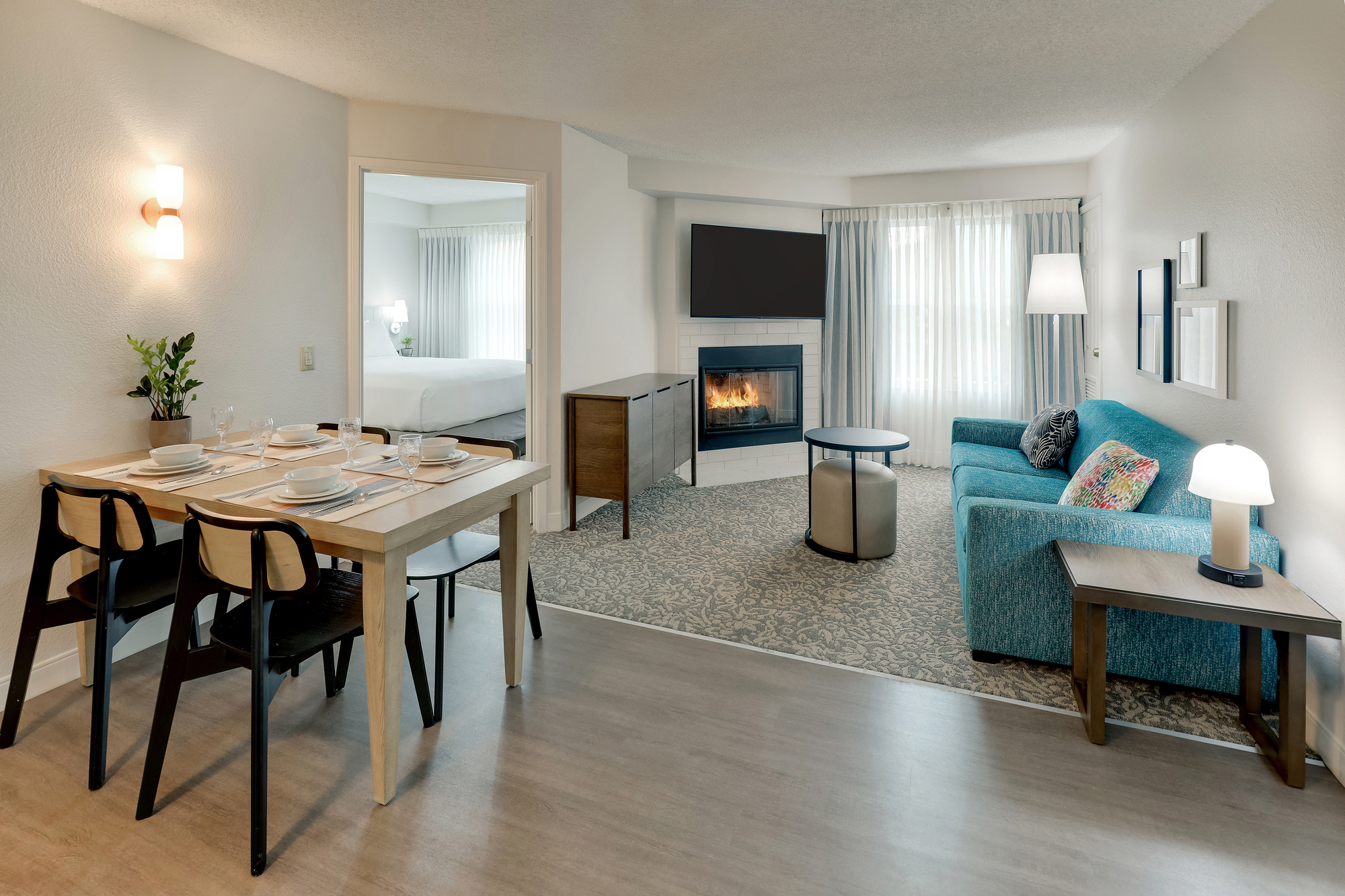
Your accommodation can function like a home for a stay of five nights or more.
The standard hotel discount saves 10% to 15% on the initial nightly rate, but that upfront number rarely reflects the total cost of a multi-night stay.
Comparing the real-world operational costs of life on the road shows that a fully functional kitchen can save you significantly more on food alone.
Here is a cost comparison framework for weighing a suite with a kitchen against a standard room discount for any stay of five nights or longer, based on typical food and rate figures.
Quick Facts
- The GSA per diem rate is the federal government’s benchmark for what a traveler without kitchen access spends on meals daily
- Solo travelers cooking in a suite kitchen spend $15 to $20 per day on groceries, producing a food saving of $240 or more over 5 nights in a standard market
- Extended stay properties apply a weekly rate discount of 15 to 20% at the 5 to 7–night threshold, dropping the room cost at the same point where food savings are already compounding
- Running the food multiplier, rate threshold, and kitchen spec check before booking makes the booking decision on real numbers rather than the advertised nightly rate
The Core Math: Eating Out vs. In-Suite Cooking
The U.S. General Services Administration¹ sets a Meals and Incidental Expenses rate of $68 per day for standard areas, rising from $79 to $92 or more per day in major metropolitan hubs, a federal benchmark for what eating out costs a traveler.
The government’s per diem is the federal government’s own calculation of what a traveler without cooking access spends on meals daily, used to set reimbursement rates for federal employees and widely adopted as a benchmark by corporate travel policies and per diem structures.
In a standard market like Charlotte, NC, or Phoenix, AZ, the GSA baseline runs $68 per day.
In a high-cost metro hub like Jersey City, NJ, or Boston, MA, the GSA tiers scale to $79–$92 or more per day, pushing the same 5-night total to $395–$460.
Buying ingredients for in-suite breakfasts, lunches, and basic dinners runs $15 to $20 per day per person, regardless of market.
Food delivery can look cheaper than sitting down at a restaurant, but added fees often close that gap.
Delivery in a major market adds a service fee, delivery fee, and tip on top of the restaurant price, typically $8 to $15 in additional charges per order.
Ordering delivery twice a day over 5 nights adds $80 to $150 in delivery fees alone, on top of a restaurant cost that already exceeds the GSA per diem in most markets.
In–suite cooking eliminates both the restaurant markup and the delivery fee stack, creating a larger saving than the GSA-to-grocery comparison alone suggests.
The 5-Night Multiplier
Eating out at the GSA standard-market rate costs $340 over 5 nights, $68 per day multiplied by 5 nights. The same traveler cooking in a suite kitchen at $20 per day spends $100 over the same stretch. The difference is $240 in under a week.
For a couple or a family, that gap doubles or triples, often outweighing a 10 to 15% room discount entirely
🧳Next Chapter: Extended Stay vs. Furnished Rental for 30+ Days: A Real Cost Breakdown
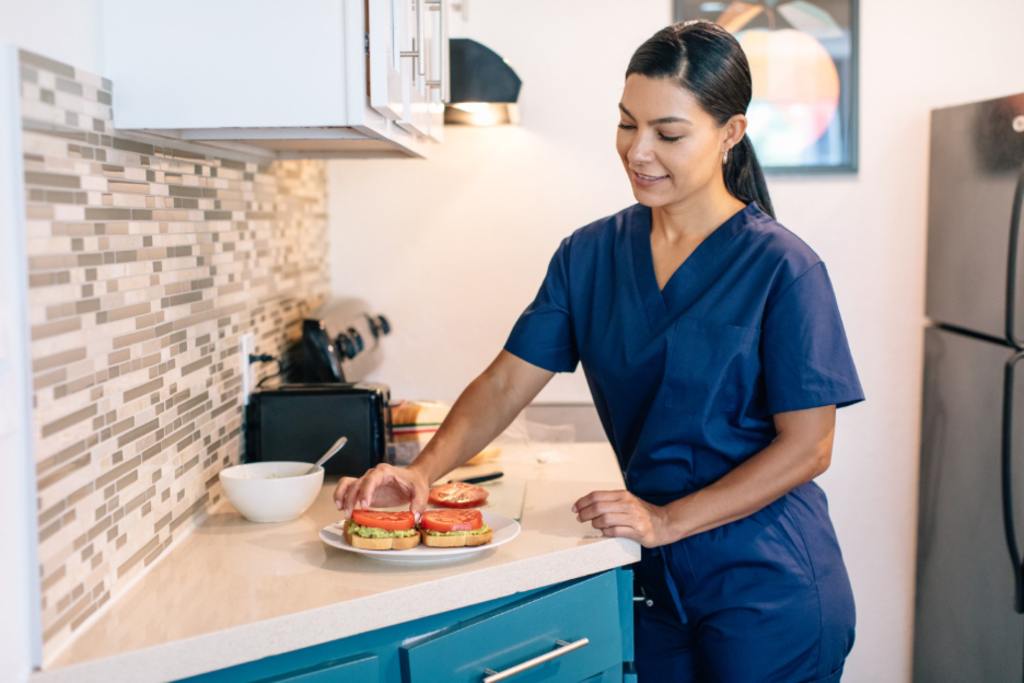
A suite with kitchen turns an approximately $340 restaurant bill into a $100 grocery run over five nights.
The Weekly Rate Threshold
Extended-stay properties apply a tiered rate discount at the 5-to-7-night threshold, automatically unlocking a weekly base rate that runs typically 15–20% below the standard daily rate, meaning the room cost drops at the same point where food savings are also compounding.
Nights booked individually price at the standard transient rate. Once a stay crosses the 5-to-7-night threshold, many extended-stay properties shift the booking to a weekly base rate, which applies retroactively or to the full week depending on the property.
When the lower weekly base rate stacks with the food savings calculated above, the total cost of a 5-night stay at an extended-stay property can compare favorably to a shorter stay at a higher-rate hotel.
The 10–15% off a standard room that most travelers look for is smaller than the savings already available through the weekly threshold plus the food math, before any additional discount-hunting is required.
🧳Next Chapter: 30 Days at Sonesta ES Suites: Cost & What’s Included
What to Calculate Before You Book Your Stay
Four calculations determine whether a kitchen suite or a discounted standard room makes more financial sense for a stay of 5 nights or longer.
- Calculate the real food multiplier: Compare the GSA per diem baseline for your destination market against $15 to $20 per day per person at grocery costs.
- Check for the weekly rate threshold: Confirm with the property whether the stay qualifies for an automatic weekly rate discount and what percentage applies.
- Verify the kitchen specs: Confirm a full-size refrigerator and a stovetop are included in the suite, not just a mini-fridge and microwave.
- Ask about a complimentary breakfast: Select Sonesta ES Suites properties include daily breakfast at no additional cost which removes one full meal from the daily food calculation.
Run these four numbers before comparing nightly rates. For a stay of 5 nights, the math often favors the suite with a kitchen.
🧳Next Chapter: How to Book an Extended Stay with Your Dog (A Checklist)
Frequently Asked Questions
The most common questions travelers have before choosing a suite with a kitchen or a discounted standard room.
Do extended stay hotels require a minimum stay to access the weekly rate?
Most extended stay properties require a minimum of 5 to 7 consecutive nights to access the weekly rate discount. Some properties accept bookings of any length at the standard transient rate, with the weekly discount applying automatically once the threshold is crossed.
Confirming the specific minimum and whether the discount applies retroactively at the property level before booking prevents rate surprises at checkout.
What is the difference between a full kitchen and a kitchenette?
Full kitchens include a stovetop, full-size refrigerator, microwave, and basic cookware. Kitchenettes typically include only a mini-fridge and microwave, which limits food preparation to reheating rather than cooking and produces significantly lower food savings over a multi-night stay.
Confirming kitchen specifications at the specific property before booking ensures the food savings math holds for the full stay.
What should I pack differently when staying in a suite with a kitchen?
Suites with full kitchens change the packing calculation for food-related items. Packing a small kit of essential spices, salt, pepper, olive oil, and two or three others, eliminates the flat grocery store spice purchase on arrival and makes cooking feel practical from day one.
Reusable grocery bags and food storage containers for leftovers reduce daily food waste and lower the effective grocery cost further over a multi-night stay.
How do pet fees compare between standard hotels and extended stay properties?
Standard hotels typically charge nightly pet fees that compound across a multi-night stay. Extended stay properties structure pet fees as a flat per-stay or weekly charge rather than a nightly one, which prevents the total from scaling with length of stay.
For a 5-night stay, the difference between a nightly and a flat fee structure can be significant. Confirming the fee model at the specific property before booking is worth the two-minute call.
The Loyalty Math
Sonesta Travel Pass is a free loyalty program that earns and redeems points across all Sonesta brands through a single account. Enrollment is free at sonesta.com, and new members receive 1,000 points on joining with access to member-only rates from the first booking.
For extended stay travelers, the earn rate at ES Suites and Simply Suites is 5 points per dollar on qualifying room revenue. Member-only rates apply at direct booking, meaning the rate advantage and the points earn happen in the same transaction.
Completing a 5-night stay at Simply Suites Jersey City with room revenue of approximately $600 to $750 depending on rate earns approximately 3,000 to 3,750 points on top of the food savings already calculated.
Relocators, travel nurses, and consultants who book multiple extended stays per year accumulate points across every stay into a single account, redeemable for free nights at any Sonesta brand including Royal Sonesta.
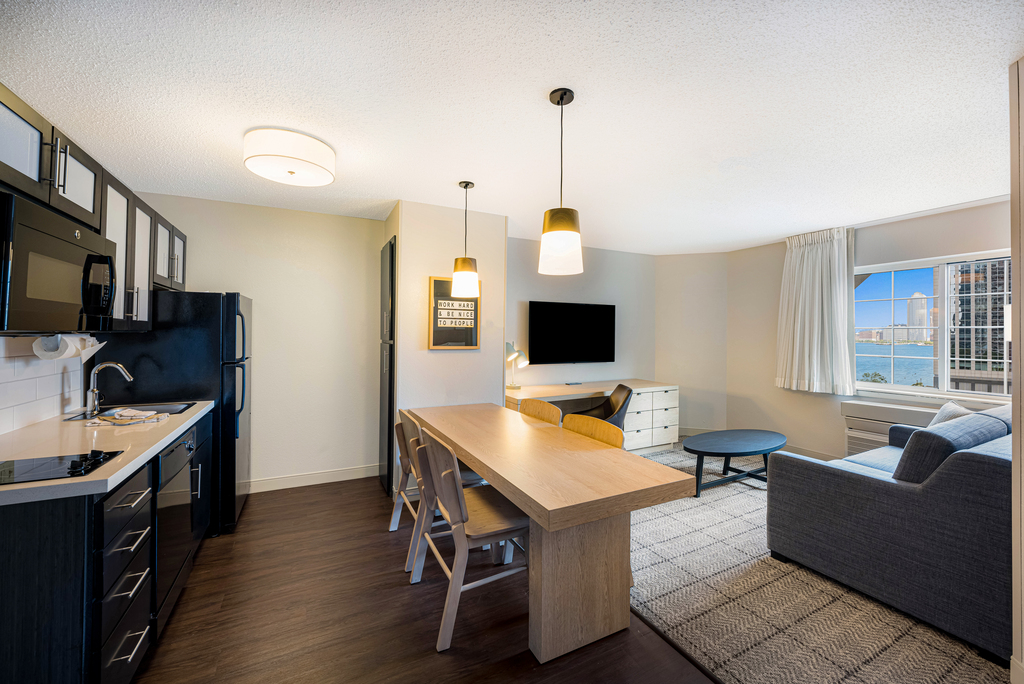
One bedroom suite at Sonesta Simply Suites Jersey City
About Sonesta All-Suite Hotel Brands
Sonesta’s two extended-stay brands solve the same kitchen-and-cost equation through different layouts.
Sonesta ES Suites: The Full-Scale Residential Suite
Sonesta ES Suites offer oversized one- and two-bedroom layouts with dedicated living and sleeping spaces, designed for families handling insurance displacement, corporate relocators, and co-working professionals who need separate space for work and rest.
The kitchen includes a full-size refrigerator, stovetop, microwave, dishwasher, pots, pans, utensils, and ample counter space.
Families can cook multiple components of a meal at once instead of working in sequence around a single microwave. Dishwasher eliminates the daily task of washing pots and dishes by hand.
Select ES Suites properties also include complimentary daily breakfast, which removes one full meal from the food math entirely and adds another layer of savings on top of in-suite cooking.
Sonesta Simply Suites: The High-Efficiency Studio
Sonesta Simply Suites properties provide a single, space-efficient studio layout built for solo mid-length travelers, traveling nurses, and corporate consultants who view their room as a high-functioning launchpad
The kitchen includes a full-size refrigerator, stovetop, microwave, and dishwasher, alongside a dedicated desk and workspace.
The genius of this layout lies in its culinary utility: a full-sized refrigerator allows shift workers to store a full week’s worth of prepped meal containers, entirely bypassing the urge to order expensive late-night delivery after a 12-hour shift.
The kitchen seamlessly flows into a dedicated desk and workspace equipped with data ports, meaning a traveler can transition from a quick breakfast straight to charting or corporate logging without ever having to clear off a makeshift dining table.
🧳Next Chapter: Which Sonesta Brand Is Right for Your Trip? A Side-by-Side Guide
References:
Disclaimer: The suggested itinerary and points of interest are provided for informational and planning purposes only. Guests are encouraged to independently verify opening hours, availability, travel times, and any potential changes prior to visiting. The inclusion of any businesses, attractions, or destinations does not imply affiliation with or endorsement by Sonesta or its affiliates. Sonesta makes no representations or warranties regarding the accuracy or completeness of the information provided and assumes no responsibility for any inconvenience or loss arising from the use of this information.